

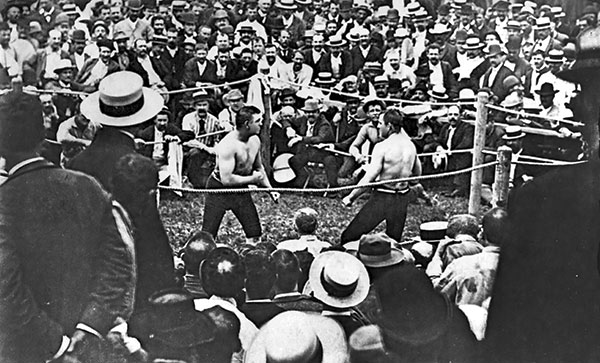
Back in the late 19th century, long before boxing became a pay-for-view TV spectacle, prize fighting was illegal in most states, including Louisiana and Mississippi. But that didn’t stop New Orleanians from flocking into neighboring Mississippi on July 8, 1889, to watch the “Boston Strong Boy” John L. Sullivan whip Jake Kilrain in the nation’s last great bare-knuckle championship fight.
Although the fight was illegal and forbidden by the governors of Louisiana and Mississippi, a New Orleans promoter made secret arrangements with Mississippi landowner Col. Charles Rich to hold the fight on his remote wooded property about 108 miles north of New Orleans in Richburg.
The match, seen here in this 1889 photograph, was not a well-kept secret. Over 2,000 ticket holders turned up at a New Orleans train station to board a special train headed for an undisclosed location. The Daily Picayune, today’s Times-Picayune, described the chaotic scene:
“When the limited express hauled out of the Queen and Crescent Depot on Sunday afternoon it carried a larger complement of passengers than usual, and a very motley gathering it was. Some were coats, while others were hatless, and not a few were almost shoeless, but somehow or other they all seemed to have money to pay their way.”
When the governor of Mississippi got wind that the fight was heading to his state, he posted troops near the Mississippi-Louisiana state line to stop the train. Undeterred, the procession kept going, ignoring the “waving red pocket handkerchief” to stop. Upon reaching Richburg, reporters asked the local sheriff if he planned to stop the fight. Knowing that would be impossible, he said he didn’t have enough deputies to do so and that a telegram he had sent, asking for a larger “posse,” went unanswered. Instead, he stayed and watched the fight.
The Sullivan-Kilrain match took place under the old London Prize Ring Rules that ranged from the size of the ring and number of attendants in each corner to what constituted fouls. Rounds ended with a knock down. Round one was over in five seconds. Here’s how the Picayune reporter described it:
“Principals and attendants met in the center of the ring and shook hands. The seconds then scattered and the gladiators faced each other for the battle of their lives. There was no chance for any fighting in the round for Kilrain clinched at once, got Sullivan across his hip and threw him to the ground, landing on top. The seconds lifted them up amid cheers for Kilrain. Sullivan took the loss of the first fall very indifferently, while Kilrain did not show any special signs of exultation, maintaining his thought. Time: 5 seconds.”
In the 44th round, Kilrain did fairly well, especially up to the time Sullivan heaved up his breakfast. But then a revived champ sent Kilrain to the deck.
By the 75th round, Kilrain had it. The Picayune detailed:
“Sullivan led with his right hand and Kilrain fell over in stopping it. The referee warned him against going down without punishment. It was not Kilrain’s fault. He could not stand up any more. (Kilrain’s second Charlie) Mitchell rushed over to Sullivan’s corner and said, ‘Will you give Jake $1,000 if we quit now?’ Sullivan said ‘yes.’ Sullivan’s backer said, ‘no.’ Mitchell was about to make further arguments when Mike Donavan threw up the sponge, saving all further parlay. Kilrain objected to the action, but Donovan said that he did wish to be a party to a murder. The referee declared John L. Sullivan the winner.”
The Picayune dedicated almost two full pages, describing the scene blow by blow, timing each round to the second until the fight ended after 75 bloody rounds. The match lasted two hours, 16 minutes and 23 seconds. But that didn’t end of the story.
Because the fight was illegal, the two fighters were later arrested. According to University of Southern Mississippi professor Mary Sheffer, writing for the “Mississippi Encyclopedia,” police picked up Sullivan in Nashville and Kilrain in Baltimore. Both were returned to Mississippi for trial and both received a year at hard labor. After various appeals, the lower court found Sullivan guilty of “prizefighting” and Kilrain “assault and battery.” Both men received greatly reduced sentences and fines.
“As a result of the fight,” Sheffer continues, “Sullivan became one of the first American sports heroes to achieve national celebrity.”
Like triumphant Caesar, that glory too was fleeting. On Feb. 7, 1892, Sullivan lost his title to “Gentleman Jim” Corbett in New Orleans at the Olympic Club before 10,000 spectators. They wore gloves and fought under the Marquis of Queensbury Rules.
