

Owners of historic homes know that their homes are a special kind of animal. The learning curve is steep; the subject matter vast. Maintenance may be a headache, but the quality of craftsmanship, the beautiful details, and the sturdiness of a historic home’s bones help balance the cons. Maintenance and replacement of windows and doors are particularly important — these entry points provide security not just from human intruders but from New Orleans’ weather. This month, we asked experts for useful tips on maintaining and replacing windows and doors in the city’s older homes.
One of the most common calls local contractors receive is the report of a window leak following heavy or sideways rain.
“I think everybody in the city has had some sort of water come in their window,” says Peter Becnel, owner of HB Remodeling LLC. “These [old] windows have been the standard window for over 150 years.”
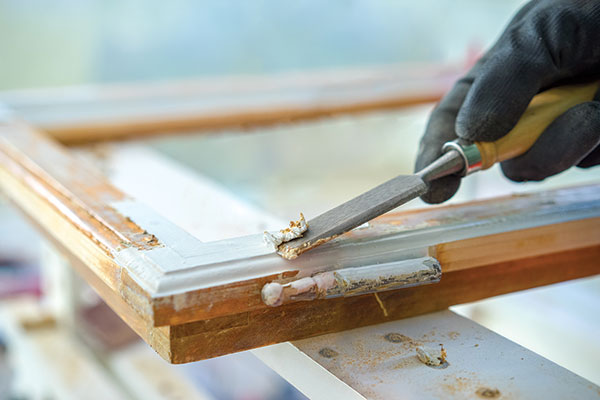
With a focus on historic renovations, Becnel has repainted, reglazed, and replaced countless wooden windows. He says that a homeowner looking to maintain their old windows should repaint, reglaze, and caulk every couple of years. Unfortunately, most people don’t examine their windows until they have a leak. If the leak goes on too long, a full replacement might be needed.
While some original windows require maintenance or an equivalent replacement to satisfy Historic District Landmarks Commission (HDLC) guidelines in specific neighborhoods, there are instances where contractors like Becnel can intermix new window technology with the old to provide better energy efficiency, strength, and security. If the original frame is in good condition, the window sashes can simply be replaced with modern ones. For homes under HDLC jurisdiction, certain windows will require specific repairs or replacements using recycled historic windows or newly milled custom windows — homeowners should consult HDLC guidelines.
“Selecting a replacement is usually straightforward but never easy,” says Will Bercik, owner of Channel & Copan LLC, a home repair and renovation company. Bercik recommends replacing the window with as close a match to the original as possible. Options include having them custom built by a local mill shop (the most expensive option), finding a suitable used replacement at an architectural salvage store such as Ricca’s Architectural Sales, The Bank, or The Green Project, or having new, more efficient windows custom built by one of the larger wholesale suppliers in the area such as Acadian Windows or Window World.
According to Bercik, a replacement project will likely require some adjustments over a couple of years due to New Orleans’ hot, humid, and rainy climate.
“New Orleans homes are constantly shifting, settling, expanding, and contracting,” he says. “Properly sealing wooden doors or windows that expand, contract, shift, and settle is no easy task since you also need them to be functional.”
This issue for windows is also an issue for the front doors of old homes.
“If during the winter you decrease the gap size between a door and door casing — to prevent water ingress or an air draft — the homeowner may find they cannot properly close the door in the summer,” says Bercik. “In this way, each individual New Orleans door or window has a life of its own.”
Historic doors present another common dilemma. According to Peter Becnel, many of the homes built prior to 1940 have doors that are around 7 feet tall with transoms above them. Modern doors, however, are typically 6 feet 8 inches or 8 feet tall. Additional discrepancies in width and thickness can further complicate matters for a homeowner looking to replace an original door. Becnel says putting in the shorter door — even at just a 4-inch difference — often doesn’t look accurate or even good from an aesthetic standpoint. Sometimes they reduce the transom and install an 8’ door. Sometimes they find recycled 7-foot doors at a local architectural salvage store.
“It can be a struggle sometimes to find something that is safe, that is weatherproof, and that is energy efficient,” he says. Becnel says the most common mistake he sees with front door replacement is a customer purchasing a Lowe’s or Home Depot door without considering their options.
“First of all, these doors are often more expensive than ones you can have custom-made to the specifications you want,” he says. He adds that the jambs don’t commonly fit these older homes — especially if the door was 7 feet — and this can reduce the home’s security and energy efficiency.
Becnel recommends homeowners in this situation seek a new, custom-made door (consider fiberglass for less maintenance) from a supplier like Caruth Brothers, where homeowners can specify all of the little-known but highly important details: style, height, width, door thickness, swing (right or left), double bore or single bore, jamb width, hinge color, threshold color, seal color, trim type, and synthetic or wood door frame to name a few.
According to Becnel, a unique New Orleans door deserves a unique New Orleans touch. Ask any homeowner of a historic New Orleans home, and they’ll tell you — love the home, and it’ll love you back. In the end, the maintenance is worth it.
