
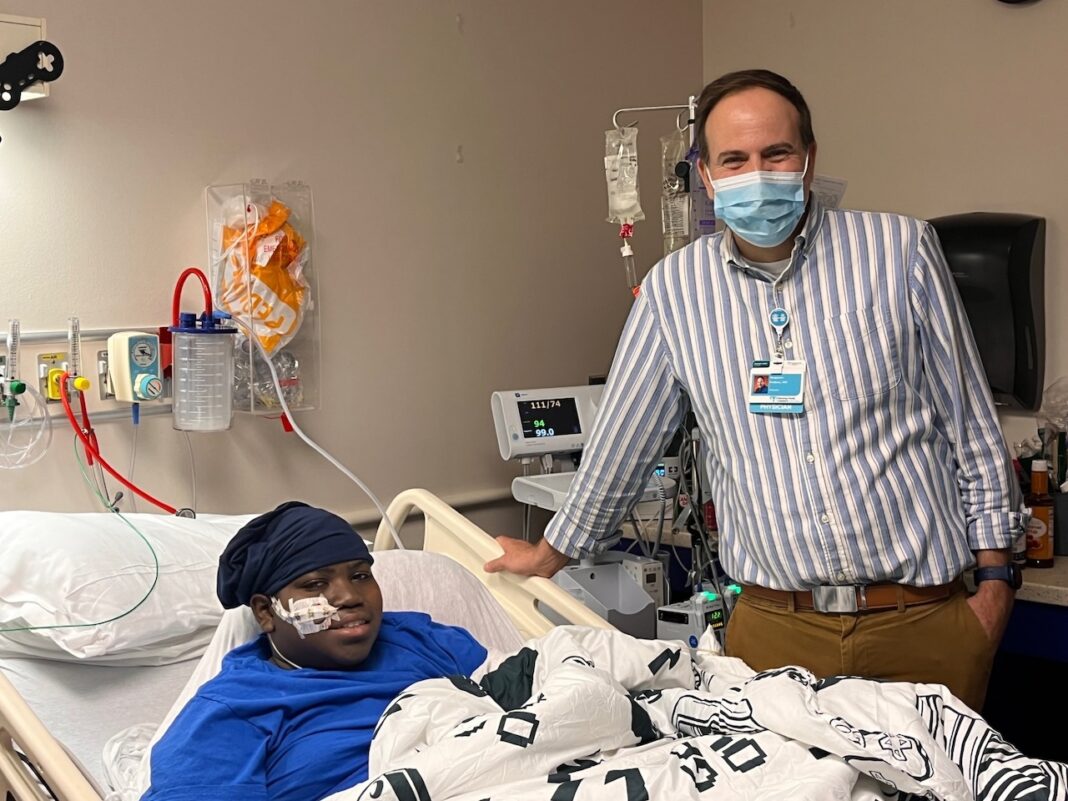
NEW ORLEANS – Last week, the news went wide that Manning Family Children’s celebrated its first cured patient from sickle cell disease.
Phillip Mullin is a teenager from Alexandria, Louisiana that has spent most of his life fighting sickle cell while in and out of the hospital. For years, a cure seemed a far away dream, but on Oct. 23, the 15-year-old rang the bell at Children’s.
In the announcement about the good news, it was noted that Phillip is the second patient and first child to receive a groundbreaking treatment in Louisiana. Phillip was cured with the use of LYFGENIA, which the announcement noted a one-time gene therapy to treat sickle cell disease in patients 12 years of age or older with a history of vaso-occlusive events.
Dr. Ben Watkins is Phillip’s doctor, as well as the director of the Stem Cell Transplant and Cellular Therapies Program at Manning Family Children’s and Section Chief of Pediatrics Hematology/Oncology at Tulane University School of Medicine.
According to the Center for Disease Control, sickle cell disease impacts about 100,000 people in the United States. Additionally, they stated that “more than 90% are non-Hispanic Black or African American, and an estimated 3%–9% are Hispanic or Latino.”
While looking more into the background of the disease and the new cures, I thought it best to go directly to the source. I had the chance to ask Dr. Watkins to break down the disease, the cure and what this accomplishment means for the hospital and its patients.
For someone that doesn’t know what sickle cell disease is – can you explain it more plainly?
DW: Sickle cell disease is an inherited condition that affects the red blood cells, which carry oxygen throughout the body. Normally, those cells are round and flexible, so they can easily move through the bloodstream. With sickle cell disease, they can become rigid and crescent-shaped or sickle shaped, causing them to get stuck in small blood vessels. That can block blood flow and cause severe pain, anemia and damage to organs over time. For many people, it means repeated pain crises, hospitalizations and other serious complications throughout their lives.
How does it impact children with the disease?
DW: For a child, sickle cell disease can affect almost every part of their childhood. They can have episodes of severe pain that come on unexpectedly, and they may spend a lot of time in the hospital instead of being in school, playing with their friends or doing the things that kids should be doing. Over time, the disease can also cause damage to the organs. So it’s not just about the pain. It’s about the uncertainty and the limitations that come with wondering when the next crisis is going to happen. What we’re seeing with these new treatments is the opportunity to change that—to give kids the chance to simply be kids and to grow up without sickle cell disease determining what they can and can’t do.
What does it mean that Phillip is functionally cured? And follow up, what does that mean for the rest of his life/health journey?
DW: The word “cure” is one we use thoughtfully when discussing gene therapy for sickle cell disease. Gene therapy does not necessarily correct the underlying genetic mutation responsible for sickle cell disease. Instead, it modifies a patient’s blood-forming stem cells so they produce more normal red blood cells that are much less likely to sickle. The results have been remarkable. Gene therapy has demonstrated the potential to dramatically reduce, and in many cases eliminate, the severe complications that have defined the lives of patients with sickle cell disease.
While we are optimistic that these therapies will provide a lifelong cure, we need more time and long-term follow-up to fully understand their durability and impact over a patient’s lifetime. Phillip will continue to require careful monitoring, both to assess the long-term effectiveness of his treatment and to address any health complications that may have developed before gene therapy.
For Phillip, the results so far have been extraordinary. Just 100 days after receiving gene therapy, he is returning home with a normal hemoglobin level for the first time in his life. Perhaps most importantly, Phillip is returning home with hope. Hope for a life spent outside the hospital. Hope for a childhood filled with opportunities rather than limitations. And hope for the future that he and his family have fought so hard to achieve.
We cannot yet predict everything the future holds for Phillip, but for the first time, we have reason to believe that sickle cell disease will no longer determine the course of his life. That is what makes this moment so meaningful.
After watching his journey and what he’s gone through at such a young age, what was it like for you to see Phillip ring the bell at the end of his treatment?
DW: Phillip ringing the bell is about so much more than celebrating the completion of gene therapy. It represents something far greater. Phillip has lived a dozen lives in his 15 years. He has endured more pain, suffering, and uncertainty than most people experience in a lifetime. He has had to face his own mortality on more than one occasion. There have been moments when he lost hope, when the burden of his disease seemed overwhelming, and when it was difficult for him to imagine a future beyond sickle cell disease.
Watching him ring that bell was an incredibly emotional and cathartic moment for me. It represented not just the end of a long and difficult journey, but the beginning of an entirely new chapter. A chance for Phillip to experience a childhood and a future no longer defined by his disease.
But that moment was about more than Phillip. It represented hope. Hope for a disease that has taken so much from so many. Hope for the thousands of children and families still living with sickle cell disease. And hope that the suffering endured by generations of patients and families does not have to continue for generations to come.
For me, the sound of that bell will stay with me for a very long time. And I believe it will continue to reverberate through the halls of our hospital, reminding all of us of why we do this work and what is now possible. Phillip rang that bell to celebrate his own new beginning, but its sound carried hope for so many others.
How significant is this treatment for the state of Louisiana and its patients living with sickle cell disease? And follow up, how accessible will this treatment be?
DW: I believe this represents a monumental milestone for Louisiana and for the thousands of individuals and families in our state affected by sickle cell disease. Louisiana has one of the highest rates of sickle cell disease per capita in the United States, with an estimated 3,000–4,000 people living with this disease. For far too long, access to groundbreaking treatments and emerging medical technologies has been concentrated in a handful of major academic medical centers across the country. While these advances have transformed lives, patients in states like Louisiana have often been left behind, forced to travel long distances or go without access to potentially life-changing therapies. This only perpetuates the healthcare disparities that already exist in our communities.
These treatments belong in Louisiana. Innovation belongs in Louisiana. Our patients deserve access to the same cutting-edge therapies available anywhere else in the country, without having to leave their families, communities, and support systems behind.
We have an opportunity to change the narrative of healthcare in our state. Rather than waiting for medical innovation to reach Louisiana, we can help lead it. And we must, because the cost of falling behind is too great.
When it comes to accessibility, it is important to recognize that gene therapy is not appropriate for every person living with sickle cell disease. These treatments are currently intended for patients who meet specific criteria, generally those with more severe forms of the disease. The treatment process is also complex, requiring specialized expertise, significant resources, and a substantial commitment from patients and their families.
Our goal is to eliminate as many barriers as possible. If a patient is eligible for gene therapy and wishes to pursue it, we want to do everything we can to create a pathway for that patient to receive treatment. Where someone lives, their financial circumstances, or their ability to navigate a complicated healthcare system should not determine whether they have access to potentially curative treatment.
Ultimately, this is about more than bringing a new treatment to Louisiana. It is about ensuring that where a child is born does not determine the opportunities they have to live a healthy life. Phillip’s story demonstrates what is possible when innovation becomes accessible. Our responsibility now is to make sure that he is not the exception, but the beginning of a new era of care for patients with sickle cell disease in Louisiana.
For a parent reading this whose child has sickle cell disease, what would you want them to know about the possibility of receiving this treatment?
The most important take home message from Phillip’s story is that knowledge is power. For generations, families affected by sickle cell disease have faced limited treatment options. Today, that landscape is changing. We now have therapies that offer the possibility of a life no longer defined by sickle cell disease, and we want every family to know that these options exist.
Gene therapy is not an easy journey, and it is not the right choice for everyone. It is a complex treatment that carries risks and requires an extraordinary commitment from patients and their families. The decision to pursue gene therapy is deeply personal, and there is no single right answer for every patient.
Our responsibility is not to convince families to pursue a particular treatment. It is to ensure they understand all of the options available to them, including the potential benefits, risks, and challenges, so they can make the decision that is right for their child and their family.
For anyone who is interested in learning more, I would encourage them to have that conversation with their child’s hematologist. Our team is always happy to meet with families, answer questions, and help them understand what the journey might look like.
Above all, I want families to know that there is hope. The future of sickle cell disease is changing, and every family deserves the opportunity to understand what that future could mean for their child.
Are there plans to continue this treatment with more of your patients at Children’s?
Absolutely. We have had a lot of interest from across the state and from Mississippi. We have several more patients going through the process currently and many more planned for next year. In addition to sickle cell disease, we are also now doing gene therapy for another blood disorder called beta-thalassemia and infused our first patient this week.
What do you hope for the future with treatments like this and advancements made in general in finding cures for diseases like sickle cell?
Historically, sickle cell disease has not received the attention or research investment it deserves. For decades, progress was slow, and patients and families had far too few treatment options. The emergence of gene therapy has helped shine a much-needed spotlight on sickle cell disease and demonstrated what is possible when we invest in scientific innovation. But we cannot allow that momentum to fade.
As transformative as gene therapy has been, it is not the right option for everyone. Many patients will not be eligible, while others may be unable or unwilling to undergo such a complex and demanding treatment. We must ensure that the excitement surrounding gene therapy does not overshadow the continued need to develop better treatments for all individuals living with sickle cell disease. Our goal should not simply be to cure those who can receive gene therapy, but to improve the lives of every person affected by this disease.
My hope is that continued scientific advances will make curative therapies safer, simpler, and more accessible. I envision a future where these treatments can be offered earlier in life, before children experience years of pain, organ damage, and other devastating complications. I also hope we continue to develop new therapies that improve quality of life for those who cannot pursue a potential cure.
And perhaps most importantly, I hope these advances reach everyone who needs them, regardless of where they live or their financial circumstances. A cure is only truly transformative if the people who need it have the opportunity to receive it. Scientific innovation means little to a family if the treatment remains beyond their reach.
Ultimately, my hope is that the breakthroughs we are celebrating today are just the beginning. That we continue to push the boundaries of what is possible, not just for the patients who can receive gene therapy, but for every person living with sickle cell disease. Because our measure of success should not simply be how many patients we cure, but how many lives we change.
