
It’s hard to watch Rob Savage’s oddly subversive “Other Mommy” and not think that the charms of supernatural love demons are not so different from the obsessive placation offered by AI. A monstrosity built for the sole purpose of effortless self-satisfaction, unrestricted by nuance or the sandpaper grit of common human failing, the promise of generative AI is the false offering of infinite choice, of a forever space where time is meaningless and there are no limitations on the lengths one could go to satisfy the most base of desires. It is a lie that goes down smooth, a psychoactive sedative before an elective lobotomy. It promises the unyielding attentiveness of a friend, a lover, the perfect parent who always knew what to say or do to make the scrapes of growing up sting less acutely, but provides only dead-eyed devotion; a funhouse mirror reflecting in on itself into infinity until honest feeling is secondary to its market-tested, billionaire-approved counterpart. This creature – this ghost, djinn, or whatever you’d like to call it – that is “Other Mommy” is a wish-granting, soul-sucking manifestation of innocence at its most infectious and alluring. It preys on the prickliness of humanity, of relationships that promise forever but falter at the starting gun, of disappointments that chop with a dull and rusted blade into the core of a person. It’s not fun to grow up, to sense that the boundless realms of opportunity, of reality, of the future are finite. We will all die without fulfilling the ever-dreams of a child’s willing heart. AI promises infinity while trapped in a cage, and the Other Mommy proposes the same; a tantalizing offer, and a terrifying one at that. She wants to enter your heart, to take over the levers and pulleys that operate our subconscious in her six-fingered hand, the decisions that can make living so disappointing or thrilling. What “Other Mommy,” the film, relates quite effectively is the tug of war that each of us finds ourselves in day after day; faced with the option to remain stalwart, to believe in people who will ultimately betray us, to love through the failings of others and ourselves. “Other Mommy” is somber in its horror; it takes hold of you and dares you to pull away, to seek the comfort of a softer companion, one that doesn’t so much hug as smother you into the warm black oblivion of night.
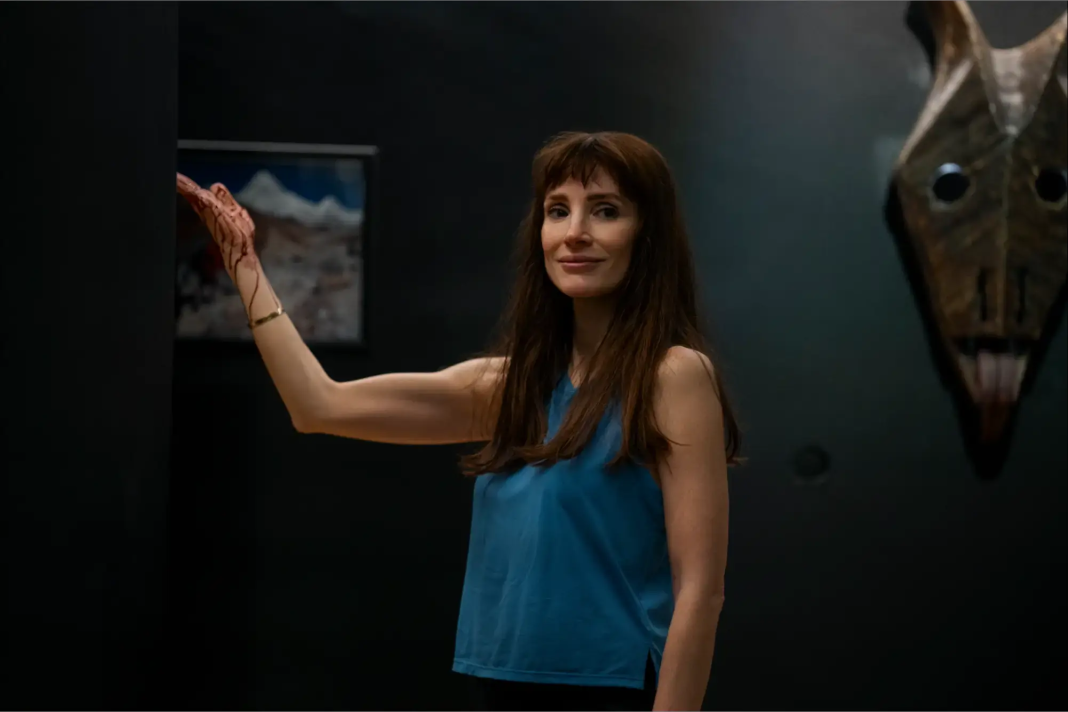
“Other Mommy” indicates in its opening moments that while this Blumhouse production might seem to be another jump-scare a minute freak-a-thon, it has the guts to zag for better storytelling frontiers than its peers. We follow a family, small and clearly cracking at the seams. Ursula (Jessica Chastain) is a career woman who doesn’t care to spend much time at home. That’s a job for her husband Russ (Jay Duplass), a lovable if inept stay-at-home dad who takes over the more whimsical rearing of their young daughter Bela (Arabella Olivia Clark). Bela can see that her family is falling away before her eyes, even though Russ and Ursula do their best to shield her from the harsh reality of their disintegrating marriage, the knowing looks, the terse kisses, and promises of missing dinner for “working” late. Soon, we see that Bela has a friend who has been filling the gap left by her mother’s absence, a Cheshire grinning, shape-shifting entity that often takes the form of Ursula and floats several inches off the ground at all times: Other Mommy (also Chastain). Other Mommy only wants what Bela wants, or so she says. She takes the young girl on wild adventures at night, to the ocean, into the clouds; always hoping that Bela will one day welcome her “into her heart.” Bela, wary of her friend, refuses, which only angers Other Mommy; hate and love are both four-letter words for a reason, after all. Still, at the outset this feels like a pretty standard setup for a supernatural spook-show. The young daughter sees a ghost, the parents are unaware; soon we can expect little disconcerting sequences happening around the house as the parents slowly become aware that Other Mommy is no figment of Bella’s imagination but a real manifestation of their now unrequited negligence. This is where the film pivots, when I leaned in. You see, not ten minutes into the movie, Russ becomes aware in no uncertain terms that Other Mommy is very real. Soon after, Ursula does the same. In short order, the film goes from a standard haunted child picture into something far more interesting: a family on the run from a malevolent specter that can twist and rewarp reality at her choosing; who can kill, in manners both bloody and unnerving, at the whim of Bela’s childlike desires. For this family, there is no way out but through; no killing Other Mommy without facing down the unspoken glass slowly digging into the soft scar tissue holding them together, a shattering of innocence that, in many ways, is a far scarier prospect to overcome.
The way “Other Mommy,” written by Nathan Elston based on the novel “Incidents Around the House” by Josh Malerman, dramatizes the gossamer-thin line between harsh reality and the undiscovered countries of a child’s imagination felt familiar but fresh, creating a tangibility that only made the oblong blood trail left in the creature’s wake punch closer to home. While there are scares aplenty, there is never a sense of manipulation, of leading an audience toward a cheap jolt. Each sequence feels purposeful, thematic, and real. Savage’s skill with a scare is what made him known from his first film, “Host”, the zoom-based COVID demon possession project that had us watching through our fingers even in the comfort of our socially distanced homes. While he has attempted more meaningful work with his last film, “Boogeyman,” the results felt disjointed and imprecise; horror without the marrow-deep relatability needed to truly care for, and fear for, those in the clutches of supernatural evil. Perhaps it is in the adaptation of Malerman’s novel that the film’s foundation is able to find sure footing because much is mined about our hero characters from the simplest of glances, the tersest of touches, and the well-honed ability of adults to shield their souls from their children. While Savage’s ability to craft thrilling horror sequences is on full display here, lavishing in the bloodletting of those who happen to cross Other Mommy’s path, the most cutting sequences are the ones shared with Ursula and Russ as seen through the eyes of Bela. This is a family that is real and broken, marked for death against the best wishes of all involved. In their love, they lie to each other, to themselves, in the hope that the lie will forestall the inevitable. After a particularly gory murder, the family takes refuge in the parking lot of a strip mall, just one lonely practical car in a sea of thousands. Bela pretends to sleep as Ursula and Russ discuss infidelity, the dam breaking of truths unspoken but long known. We watch as Bela watches what she was never meant to see or hear, a piece of calm dying in her eyes in real time. For the film to focus on her, on them, on this moment amid the chaos around them is bold, audacious, and perhaps even self-immolating. “Other Mommy” is not a simple Halloween horror; its aspirations are far grander and stickier, the kind that may bounce off some audiences, but if stuck, hold on for dear life. Consider me stuck.
There is a sequence late in the film when Bela sits on a beach with her estranged, ghost-obsessed grandmother (Karen Allen). In this quiet moment, the older woman kindly imparts some wisdom that the child’s parents perhaps do not know, or won’t allow themselves to reckon with. The value of life is not in its simplicity, not in its cold efficiency or the assuredness of happiness. People will lie, especially people who love each other. They do it often for love, though innocent flesh still splits on impact. Growing up is the ever-dawning realization that we will die, that bruises will come from those we allow close enough to punch. It is a march toward our own inevitable destruction; one that is precious, where the scars we accrue are to be treasured and held up to the light as witness marks of a life well lived. The scene is simple but speaks to the horror and wonder that “Other Mommy” offers. The whimsy of eternity may be scintillating, but it is also damning. Love unabated only swallows; it does not offer much in return- no easy answers, no shortcuts, no stays of execution. While Bela does ultimately find power in shedding the naiveté of childhood, the film knows that what she has left to face are monsters far grander than Other Mommy could ever be. In many ways, Other Mommy was a friend, a kindness, a balm. As the film concludes, Savage leaves us with one of my favorite final shots of a film this year: a devastating still life of regret slipping through the honest mask of love, proof that there are no happy endings and that each of our stories ends in death. We can’t shield that from our children forever, and it will ultimately break their hearts. Ours too. But we are all the better for it.
“Other Mommy” is going to be a divisive film. Much like last year’s “The Monkey,” it’s a story of facing down the oblivion of time and death, of the imperfection of people and our dogged persistence in the face of our own failings. It made me feel deeply, to consider myself, and how I relate to those I love. It also frightened me and made me yearn for the siren sound of a calm voice to tell me that everything is OK, will be OK, always was OK. It wasn’t, it isn’t, and it won’t be. That’s being human, and all we can do is do the best we can with what we have and are. The sooner we accept that, the better.
Come to Mommy.
You’ll be glad you did.
“Other Mommy” is playing at The Broad Theater and Prytania Theaters at Canal Place.
