
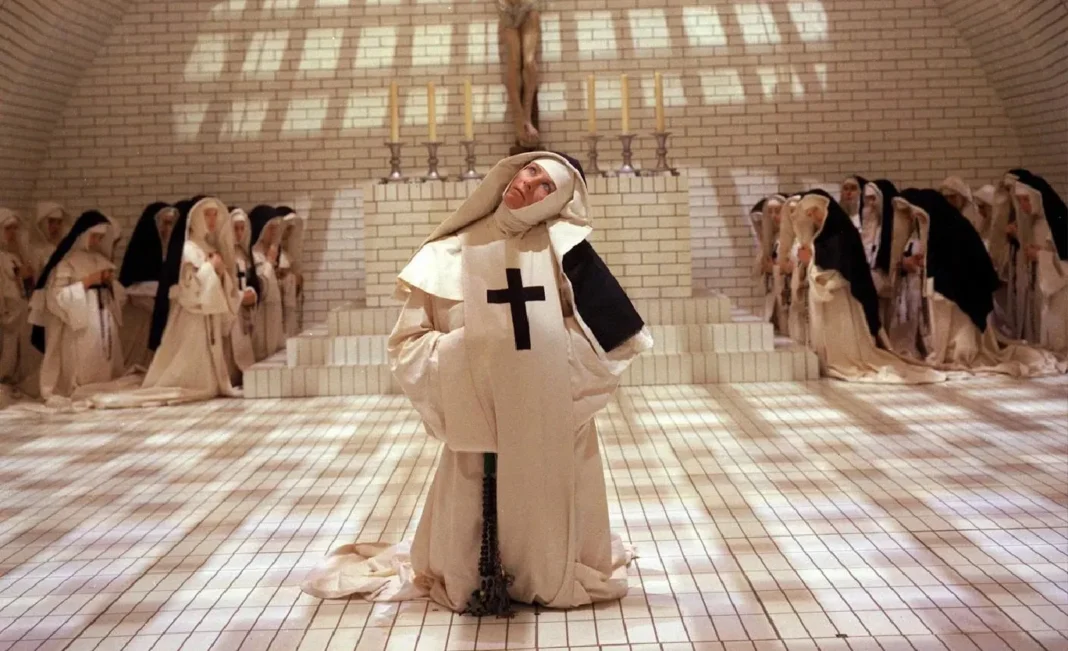
The accusations of abhorrent blasphemy that have plagued Ken Russell’s “The Devils” since its initial, controversial, and quite heavily censored release in 1971 are largely a matter of perspective. The film, dramatizing a true-to-life event where seventeenth-century French nuns proclaimed that their local priest had seduced and possessed them with the spirit of Satan, does certainly feature its fair share of religious iconography being defiled, maimed, destroyed, and perverted. There are sequences of rampant mania, orgies of the flesh and of the sacrament, of garish repression; yet while the film’s target is assuredly the Church, that does not mean that its gripe is with the divine. Quite the contrary, “The Devils” is in many ways a deeply spiritual film, an upsetting and outlandish one, but a story of faith and goodness that somehow perseveres in the face of overwhelming destruction and oppression. While the imagery bestowed with transcendence of the ruling monolith of Christianity, specifically Catholicism, is certainly warped and repurposed for psychosexual means (the Eucharist of transubstantiated body and blood), Russell is no sadist, no narcissist; in fact, it is clear for those with eyes to see that he is a humanist, deeply compassionate, and scornful of the vengeful wolves cloaked in a redeemer’s shrouds. It is fascinating that Warner Bros. perhaps imagined that this film’s rerelease, the Director’s Cut, would get some attention for its titillating exploitation, its shock value, especially as a cheeky zag in Halloween season programming. But what they perhaps could not have anticipated, and what I believe is the primary factor for the film’s growing attention in theaters around the world, is the deeply pertinent and shockingly relatable horrors that this half-century-old story still holds for us living today. “The Devils” is the sort of film that revolutions are foisted upon; dangerous, enlightening, and transformative. No wonder they were afraid to release it.
“The Devils”, based on the historical truth but also the 1952 non-fiction book The Devils of Loudun by Aldous Huxley, places audiences in the midst of a world nearing an apparent apocalypse. It is 1634, and while the King of France stages opulent operas to his own magnificence and decadence, the people are dying of the plague while a war wages between the ruling Catholics and oppressed Protestants. Ghouls in the garb of surgeons and chemists poke and prod the sick with the glee of madmen, and above it all, pulling the strings of power with the deftness of his apparently holy charge, is Cardinal Richelieu, who hopes to eradicate any distinction between the Church and State of France. In Loudon, a fortified city where Christians of all denominations are welcomed, Father Grandier (Oliver Reed) operates at the cross section of the carnal and the divine. A womanizer whom most of the city seems to lust for, Grandier is dismissive of their affections yet cannot help but give in to the temptation, seeing the degradation of his own flesh and spirit as a gateway to further understanding the plans of God. He is no heretic, merely modern, seeking to learn what he can from experience and leading with compassion despite his clear pride and enjoyment of power. But as the ruling factions of France descend upon Loudun, he is forced into conflict with not only the King, but the Church itself. Meanwhile, an Ursuline Convent operates; the nuns, cloistered behind tall, sterile walls, themselves harbor fantasies of Father Grandier, the closest manifestation of God made flesh, which their devotions allow them to desire. Sister Jeanne des Anges (Vanessa Redgrave) is a poor, partially deformed woman who cannot help but yearn for the favor of Grandier; her mind undone by the indentured nature of her order. Soon it is not Grandier’s infidelities that turn his enemies against him, but love when he marries a woman in the sight of God. And thus begins a coercion, beginning with the spurned ravings of Sister Anges, where power uses the fanaticism of the Church to spurn regime change in Loudon, thus uncorking a thousand years of sexual frustration and manic glee which mean to dismantle the city brick by brick, and Grandier with it.
There is a concept of a sin eater in certain societies who is meant to be the receptacle of a community’s moral transgressions; in a way, not much unlike a priest and their absolution. They were meant to rid a deceased person of their worldly ills, to grant them safe passage to heaven through a performative act of purging. The power of this ritual was in one’s belief in its efficacy; what other power might the formalities of religion offer than what we give ourselves over to. “The Devils”, viewed through the lens of the modern world, means to present a similar service; a film whose orgiastic and gleeful smearing of the Catholic doctrine can offer similarly regurgitative effects, if not considered. We go to the cinema to believe, to gaze with upturned eyes at stories, fables, parables, meant to alleviate us from our world suffering for an hour or so; a transference of pain, joy, sexual desire, and culpability into something that lives only for the second it passes from the screen to our eyes. That was, surely, the appeal of “The Devils” for many years; a scourging treatise that railed and flailed in the face of good taste, a back alley paperback with the pages stuck together passed from acolyte to acolyte. Surely, many people wandered out of their homes in the past few weeks intrigued by the image of Vanessa Redgrave in her Nun’s habit chained in a pose that indicates bondage, torturous or perhaps even wanting. The promise of some despicable vision of cinema from the heyday of dangerous moviemaking, the 1970s, is intriguing, but flaccid in its own way. What would it take to shock an audience today? Death and exploitation have never been more accessible. Satire of the Church is old hat, in many ways. Even Marilyn Manson, the boogeyman of late 90s Focus on the Family pearl-clutching, was himself revealed to be monstrous not in his music and performance but in his actions; his own perversion of power and privilege over another living soul. In that way, if few others, he shares a kinship with the worst indulgences of the Church; any church, any country, and person, for that matter. This here is the point, the key to all that “The Devils” has to offer us today. Power knows no ordination or edict; it cares little for doctrine or goodness; it speaks the words of holy men as a blasphemy against the very syllables. If wielded by the damnable, the ravenous creatures hiding behind gold varnish or the false pretense of the Church, the symbols which signal virtue are less than the sum of their design; a crucifix is merely a slain tree, a flag is merely smeared dye on loose fabric. They wield these objects as holy relics not because they believe but because we do; we want to, need to, or else face the cruel reality that there is little fairness on this Earth. As Russsel presents it, the Church and State of “The Devils”, devoid of passion and fueled only by the worst impulses of flawed humanity, are very much one and the same; ravenous in their desire to taunt, to poke, to inspire, and destroy with our own eager consent. How else can you describe the central sequence of the film, as the Ursuline nuns, tortured and threatened with death if unwilling to proclaim the Granier to be in league with the devil, flaunt and cackle across the floor of Loudon’s church? They bare themselves, burn holy texts, grind and grovel and growl, and defile the crucifix they had sworn their lives to worship. Most telling, as they perform this lurid display of coerced sexual liberation, there in the background stand the people of Loudon, laughing, cheering, jeering, partaking in this most enlivening sacrament of the flesh. They see what is happening but won’t allow themselves to believe it is horrific, that it is monstrous and against the truth of Christ’s teaching they pretend to follow. They get along to go along when the alternative is death; who among us can say we may do otherwise. Films are often meant to make us feel grand, hopeful; that WE may be the stalwart hero standing up to the obvious and ugly oppressors. But watching “The Devils,” I was struck more by how I saw myself, and all of us, in those wide-mouthed, howling masses pointing and puking and weeping as the dance of the damned played out before them; convinced they were doing what was right because the men for whom God had ordained their power told them it was so.
“The Devils” is not a subtle film, but it is one that begs to be devoured like so much bread with the texture of divine flesh, to be swallowed like blood from a golden cup. The sin that we eat is not merely our own; it is that of those who came before us, who built this crumbling tower of belief that those above us mean the best for us. They play shadows on the wall, and we laugh as the dirt and the mud and the flood waters swell around us. If only it would rise quickly, maybe then we would have some chance to one day touch the Heaven we were promised before we drown and sink as one body, together again.
Pray for us.
You’ll be glad you did.
“The Devils” is playing at The Broad Theater and Prytania at Canal Place.
