
I was crying from the opening frames of Brian Duffield’s “Whalefall.”
You can say it was the power of the film’s initial image that caused it: a frail, hacking Josh Brolin lying back on his boat with the sea boiling down and around him. Or maybe it was Josh Trapanese’s score, which slices into the soul with synth and strings that bite and tear. Either way, a feeling of dull, aching grief hit me mercilessly and with surgical precision. Because I knew what was coming. I knew from the first sounds of Brolin coughing over black title cards, having read and loved Daniel Kraus’ masterful novel, which the film is based on. But this scene isn’t in the book, not really. It is in many ways the inciting incident, a noble, if selfish, suicide at the altar of the sea by a man left feeling lost and listless in a world he can’t, or perhaps doesn’t wish to, understand anymore. It’s mournful and desperate, a plea for meaning, and a prayer for answers that may only be found plunging into a chasm without any hope of rising. To allow oneself to fall. I was gripped from moment one, enraptured and eviscerated; ferried away by the work of a filmmaking team operating as one hive mind, assassins embracing an audience into submission and squeezing until every last ounce of feeling is extracted. It’s a Brian Duffield picture, though; so I shouldn’t have been surprised. Duffield, whose previous directorial efforts include “Spontaneous” and “No One Will Save You,” was one of my favorite writers well before he was one of my favorite filmmakers. His creative coupling with co-writer Kraus, whose own works grips and twists until you’ve been taken to a place you never knew you needed to go, feels fated; the latching of kindred artists to one another, filling the stray ebbs and flows of their complementary instincts into a singular unblemished whole that is as sharp as it is warm; like blood willingly spilled for another. “Whalefall” is a rapid descent into sub-aquatic damnation, a mirror maze of tentacles and stomach acid, where the only way out is the retracing of steps down the long road back to cruel understanding. This is a survival horror picture, as anyone with eyes and sweat glands can tell from the film’s trailers, but it is so much more than that. It is so much BETTER than that. A story of fathers and sons, of failures and good intentions, of a broken world and we pitiful bipeds cursed to find meaning in the sludge of our own excretion. It is a beautiful film, one that broke my heart and reformed it from fish guts and brine into something more ready to accept the punishment of a life spent loving, something willing, nay eager, to fall.
“Whalefall” follows Jay (Austin Abrams) as he returns to his seaside home with a mission. His father, Mitt (Josh Brolin), has been dead for over a year now, his body washed away into the Pacific Ocean after taking his own life by drowning amidst a chronic cancer diagnosis. The pair had a contentious relationship. Mitt, a sea dog of the highest order, was a large man in stature and personality, who believed that the knowledge he possessed of diving, of the ocean, of its place in the ecosystem of a crumbling existence, was of the utmost importance to pass along to Jay, whether the boy wanted it or not. Jay, hoping to be his own man, eventually decided to cut ties with his father, fleeing inland as far as possible to attend college. They stopped speaking, and then Mitt died, leaving only a note behind as his last words to his only son. Jay never read the note but feels that he must do something to atone, or perhaps even to spite, his father’s final wishes. As a kindness to his mother and sisters (Elisabeth Shue, Jane Levy and Emily Rudd), who were devastated to bury an empty box in the local cemetery, Jay decides to dive and retrieve whatever of his father might be left so they can properly lay him to rest. Descending into the sea for the first time in years, Jay remembers each lesson that Mitt forcibly instilled within him: how to check his regulator, how to assure maximum oxygen retention, in short, how to stay alive. This key lesson, a treatise in survival via a million cuts, proves useful as Jay’s exploration of Mitt’s final resting place brings him into the path of a monstrous sperm whale on the hunt for a giant squid. All attempts to untangle himself from this battle are moot, and Jay is soon slurped, kicking and screaming as if an infant being returned to utero, into the belly of the great beast; swallowed and left alone to die. Any one of us would have. But not Mitt Gardner’s kid; not the son of a legend, whose life is a repository of one man’s life and passion, of ancient texts that may as well be of divine origin; the gospel of salt spray, of kelp, of blubber and bone. Soon, Jay must face his own fall with an hour of oxygen left, and, if he is to live, follow his dead father into the unknowable darkness below.
“Whalefall” is a miracle because this story is beyond adaptation. What do you mean you’ll set an entire movie in the belly of a whale, a real whale? It’s a gargantuan task, but that’s only the half of it. The far grander challenge is using that practical horror to tell something more intricate and complicated: the tale of a father blinded by his own ambition to offer all of himself except the parts that matter to his son, who loses everything along the way, and is redeemed by the very child who loved and shunned him. Mitt Gardner is no saint; if anything, he’s a self-styled martyr. Jay cannot understand his father’s obsession with the sea, with wanting to be a part of it far more than he wishes to engage with terrestrial life ashore. Mitt also is no monster; however, Jay may have seen him as such when he was a boy. As played with grace and soft authority by Brolin, Mitt is a man, sad and broken, who once held the tiny body of his son in scarred hands and promised to give him the world. He meant it too, and he tried his best, but we are cursed with our best ever falling just a bit short. Perhaps that’s how it is supposed to be. How are children to grow if their parents are not worth growing beyond, improving upon, rising above? The crumbling core of “Whalefall” is in this question; in the inexorability of a son from a father, bound by unbridled love and half-broken promises. It’s a story that will always end in unsaid things, in questions unasked, regrets that things could have gone better if only there had been more time. But there will never be enough time. It is the solemn soul of the film, the false pretense of man that we believe ourselves to be infinite, as if “ourselves” were of any importance in the slightest. We believe immortality comes from what we pass on, our hard-won wisdom and what we value most about ourselves. But in truth, that’s too much to ask of squalling creatures of soft flesh and lungs ripped from the belly of a mother and into a hostile world. They don’t need what we think is important; they’ll make that decision for themselves. They just need to be heard, to be understood, and to be embraced as worthy of love untethered. It’s a high wire act this movie is tasked with nailing, which it does with crippling aplomb. And that’s before we even get to the godforsaken whale.
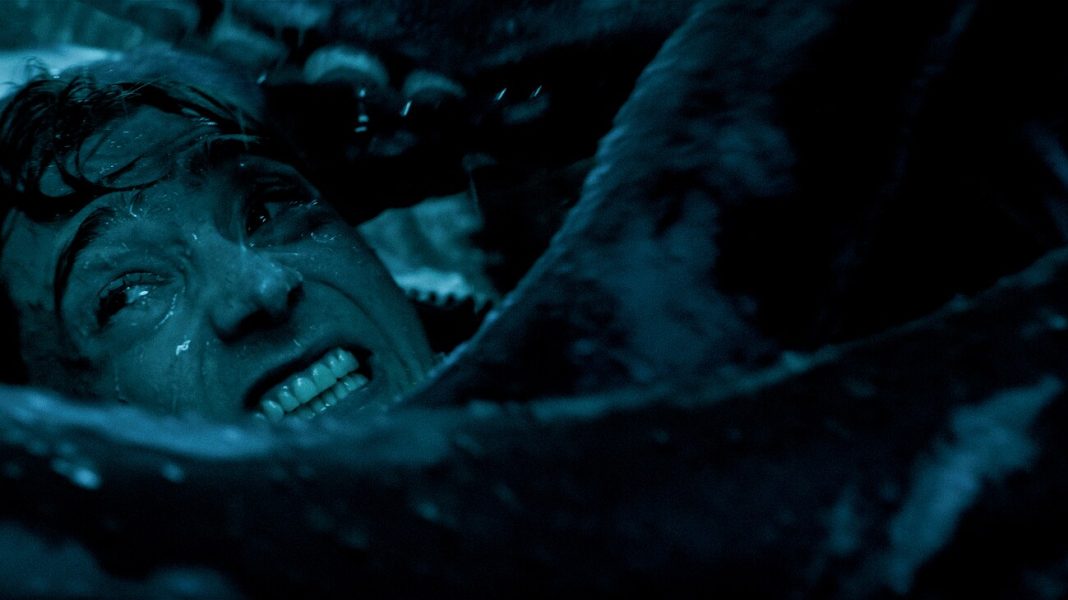
“Whalefall” is a sterling example of what filmmaking could be if given the space to flex: of writing and design, of performance and craft, of Aaron Morton’s photography and Ramsey Avery’s production design. Most of all, it cannot be overstated the importance of Austin Abrams as Jay in this film. Tasked with essentially being the only person onscreen for over half the run time, he is wrenched and bloodied, scarred and burned, a rag doll brutalized by an ageless vessel that does not even know he is there. It’s terrifying, the prospect that Jay is forced to confront: the nightmare hate child of a claustrophobe and a thalassophobe’s worst imaginings. That the book is as scientifically accurate as humanly possible is little assurance that what Jay confronts is survivable for anyone but him. There’s a sickening tangibility to the stomach and juices that Jay is forced to sift through as he climbs and tumbles along the paths of his own real-time digestion. This whale was built practically; that is Abrams in that space, flailing and crying, hunched and determined to live to spite cruel circumstance. Photos and videos from the set of the film illuminate and further mystify the task of dramatizing this story, of making it feel visceral and impossible to escape. If the film were just this, body horror subverted upon itself, then “Whalefall” would already be an achievement; a crowd-pleasing thrill ride. But that is only the first half of the film, merely the stage setting for what is to come. Eventually, we leave the belly of the whale, at least in Jay’s mind, and enter a fantasia of underwater ballet and brutality; a tapestry of dance and death as the whale itself becomes less a captor than a fellow traveler also facing an imminent dalliance with eternity. Duffield may as well be juggling chainsaws on a tightrope for his eagerness to layer this much complex cinematic language hand over hand, but of course, this is the reason to make the movie in the first place. The final thirty minutes of “Whalefall” are when the dam, which had been threatening to crack wide open from the opening scene, fell away, and I couldn’t stop myself from sobbing. Here was the promise of the film laid out as it in full, as it excavated what it means to be a son and a father, a person who can only see the vastness of a life at its very end. Death is a door we inch towards one day at a time. No amount of love can stop its encroachment. All we can do is share not what we know but what we are, a willing heart offered, beating red and raw, to be consumed and carried as a beacon to light our way through the depths together.
“Whalefall” shouldn’t exist, and it is all the more precious for its dogged stubbornness to do so in the face of all practical reason and logic; a testament to love itself in many ways. It will thrill most and terrify many, but it cut me to my core. So far as movies go, I will hold this one close as life rockets forward into an unknowable future that is more horrifying than any whale stomach could ever muster. I know it will dissect me again, this movie, leaving my soft bits to be nibbled and consumed as if by ocean creatures hungry to rebuild an ecosystem from the willing remains of another. Life and love go on, and I am grateful.
Rise.
You’ll be glad you did.
“Whalefall” is playing at Prytania Theatres at Canal Place.
*It is worth mentioning that I am lucky enough to consider Brian Duffield a friend and have worked with many of the people involved with this movie. Take that for what you will.
