
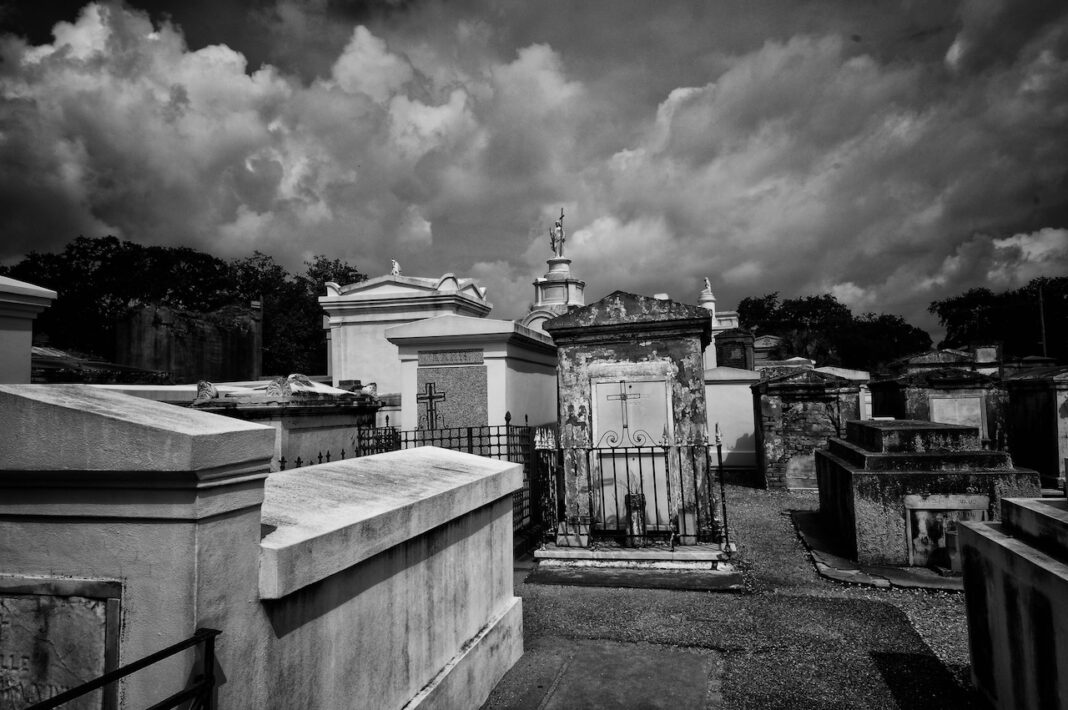
New Orleans is good at Halloween. There is masking, plus parades, and lots of partying. But let’s not overlook the day after; All Saints Day, which, more than Halloween, is really part of the soul of the city.
Halloween’s ancient pagan origins are from Celtic beliefs in honoring the deceased who, legend had it, would rise on Oct. 31. That was the eve of the day that pagan tradition said was when the departed would revisit the living world. It was a symbolic merging of the past and the future.
Tracing the origin is a complex task that long ago lost its spiritual significance, but nevertheless Halloween is the eve of All Saints Day. It deserves more attention. In New Orleans, we are known for our cemeteries. The tradition has been to use above-ground tombs rather than burial plots. The early cemeteries were built outside the city’s borders. For example, St.Louis I and 2 cemeteries are located on the edge of the French Quarter, which was the original city.
Because New Orleans once had such a dominant Catholic population there was more attention paid to All-Saints Day. I remember going to school on All-Saints morning and seeing vendors outside the cemeteries selling chrysanthemums (mums) to those going to visit tombs. It was traditional to use the day to tidy up the tomb sites while placing the mums. Some sites, such as Metairie Cemetery, still hold an outdoor Mass each All-Saints afternoon. The crowd is so large that many attendees carry their own folding chairs. It is appropriate to have a picnic near the tomb where the talk is invariably about remembering the deceased.
In keeping with the historic nature of the city, there are celebrity tombs, the most famous being the one alleged to be for Voodoo Queen Marie Laveau. Governors, generals and kings of Carnival are also housed nearby.
Near where the expressway passes alongside Metairie Cemetery is the former tomb of Josie Arlington, famous for having operated a bordello in Storyville. What was thought to be a mysterious red light once reflected on the tomb. The mystery was resolved when it was discovered that the light came from a nearby traffic light back from the days when there was a canal alongside with signals from barge traffic.
Confederate President Jefferson Davis was once entombed at Metairie Cemetery though his coffin was later moved, with great protocol, to Richmond, Virginia.
New Orleans was once the home of the person who would be the first American to be recognized by the Catholic Church as a saint. Though a native of Italy, she spent most of her working life in the United States establishing orphanages and schools in New Orleans, Chicago and New York City.
Canonized in 1946, Frances Xavier Cabrini is the best-known saint associated with the city. There are other names on the list being considered, such as Father Francis Seelos, the Redemptorist priest who is remembered for his work during a yellow fever epidemic and ultimately died from the disease.
Though there is nothing spiritual in the date, All Saints Day Nov. 1, 1966, was certainly an uplifting moment in the city’s history. That was the day that Pete Rozelle, the Commissioner of the National Football League, came to town to announce that New Orleans would be awarded a National Football League franchise.
From that day on the conversation in the city, especially on Autumn weekends, would frequently be all Saints.
-30-
To contact Errol, email elabordenola@gmail.com.
BOOK ANNOUNCEMENTS: Errol’s Laborde’s new book, “When Rex Met Zulu: And Other Chronicles of the New Orleans Experience,” (Pelican Publishing Company, 2024) is now available at local bookstores and websites.
Laborde’s other recent publications: “New Orleans: The First 300 Years” and “Mardi Gras: Chronicles of the New Orleans Carnival” (Pelican Publishing Company, 2017 and 2013), are available at the same locations.
