

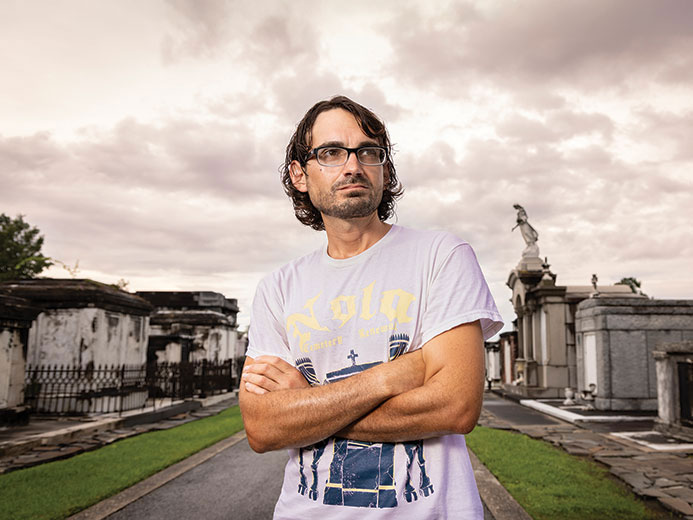
New Orleans is often called one of the most haunted cities in America. The ghostly stories of vampires, magic and spooky mayhem are part of the fabric of the city itself. So, how does one become a professional in the middle of it all? Nick Black unexpectedly found himself at the center of the artistry and preservation of some of the city’s ground-zero (literally) for spooky stories, our famous cemeteries, through his business NOLA Cemetery Renewal, as well as acting as the current sexton of the Cypress Grove and Greenwood Cemeteries. We found out more about his unearthly profession, historic preservation and what working among the dead is really like.
How did you get into the world of preservation and cemeteries? [After] I was in school [at Nicholls State University] for marine surveying, me and my dad we were restoring an old wooden sailboat. One weekend we decided we’d go and fix up my great grandparents’ plot in Cypress Grove Cemetery. We went and we’re just working on it together and he made the comment on how there’s a whole lot of work that needs to be done out there. I enjoyed doing the work. I’ve always gone to the cemetery, and I thought, I could do this. Never thinking it would become a full-time job. I honestly thought it would be something I would do on the side just because it felt rewarding. But it turned into a full-time career and it really blew up.
Describe the job of sexton and how you got the job at Greenwood Cemetery? I have my business [NOLA Cemetery Renewal], and then I [also] have where I’m a contractor. About six years ago I was asked by Greenwood Cemetery if I’d like to be sexton. It’s the last cemetery to have actual sexton. Back in the day, the sexton would bury the people, and he sometimes even lived on site, and he would build the tombs. It was like an all-in-one shop, whereas nowadays it’s really not like that. It’s more that we have crews and, and whatnot. But they asked me to be sexton and I was like, sure, yeah. A few years before that, I was restoring a tomb in in an Uptown cemetery and I became friends with the municipal cemeteries grave digger, Mr. Daniel Jackson. He had been the grave digger for 50 years, and we became friends, and I was helping him. He would watch me restore the tombs. We just hit it off. One weekend [he asked] if I didn’t mind lending him a hand with a burial, and I was curious, so I said yes. And then one weekend led to another weekend and he kept asking me. He enjoyed it. He called it his art. I liked how he took pride in it. One day I received a call from the city that said Mr. Jackson had an emergency, and he wasn’t able to return, but he gave them my number if anything ever happened to him. The city expected me to step up, and I couldn’t [say ‘No.’] Since [then] I’ve technically also been the contract grave digger for the City of New Orleans.
What does a typical day for you look like? The majority of my days I get into my office in Cypress Grove around 5 a.m. each morning. That’s the time when I do all my office work and the sexton office work. Around 8 or 9 a.m., I leave to go and start projects in the cemetery. I try to always have one big project going, whether it’s building a tomb or restoring a large tomb. Within the week I’ll always have smaller projects to complete. I’m outside until 2 or 3 in the afternoon.
What does the process of restoring a tomb in New Orleans actually look like? We have individual family tombs, and then what they call ‘society tombs.’ Back in the early 1900’s and late 1800’s, you would be part of a club. Every Italian society had their own, the French society, and then the boil makers or the carriage riders. It was usually [a] profession or religion or something like that, but they had very large tombs. It’ll be like 3 or 4 family-size tombs basically in one. I go, check it out, survey it, give the family or the society a detailed proposal of what needs to be done. Like everything, it comes down to money and how long it’ll take me to do the job. I’ve gotten pretty good where I can look at [a tomb] and I can pretty much tell what I’m going to end up finding when I get down into it, but there are surprises sometimes. When you start taking things off you realize like it’s much worse than you possibly thought. Everything was brick back then, so, the bricks are falling apart; the roof’s caving in; sometimes I have to deal with moving the remains.
What are some surprises about you’ve learned through your job? I’ve said this to somebody before, and I say it respectfully, but we are so much dumber now than we were 100, 200 years ago. We have lost all sense of how things operate, how things work. I’d say with cemeteries, local New Orleanians, they really don’t know how tombs work. There’s nothing pretty about somebody dying and being put in a tomb. It’s not a process that’s clean. It’s not a process that’s glamorous. They are strictly functional structures. I think the biggest misconception is somebody who’s put into a tomb, that they’ll rest at peace, but you’re never really fully at rest in New Orleans. If you’re in a tomb, chances are you’re going to be moved. You’re going from the top to the bottom; you’re going to be taken out; you’re going to be transferred. In the ground, you’re in the ground. However, in our graves here, we reuse graves, so you’re being dug up, your remains are being collected and they’re going somewhere else in the grave.
What are some of the biggest threats facing our historic cemeteries? I would honestly say it’s a combination of families moving away, not using their property anymore, and [being] abandoned. The majority of the tombs in most cemeteries are abandoned. I can tell you in Greenwood alone, which is the biggest cemetery, a quarter to almost 50 percent are probably abandoned. We’re also past the 50 percent mark with cremations. Each year it’s getting more and more. At Greenwood we’re at 65 to 70 percent cremations, versus people who are being put in caskets, so I think that it’s less people that are using the cemetery because we have less and less burials each year. And that’s every cemetery.
What happens to a tomb when there is no family left to take care of it? It sits there. There is the Louisiana Cemetery Board and state laws. We do have rules and regulations for what we can do with property since it’s all personal property. There’s only so much that the cemetery authority can actually step in and do. So if it becomes public danger, the cemetery can step in and do something, but in terms of fixing up a tomb to basically start using [it] again, to sell [or] to have another family, it’s [a] lengthy process of having to try to find the owners or the descendants. Sometimes it’s difficult because the tomb could be 150 or 180 years old and finding people who are still around is not easy.
What is the best part of your job? Honestly, I would say being able to express myself, creatively. I think a lot of people would think it would be more about the dead and showing respect and honoring them, and it is. But I mean, to be perfectly honest, if I’m not doing something with my hands and I’m not making something, I’m not happy. I like being able to put people’s loved ones away and they feel comforted, that does make me feel good, but what really makes me happy is just being able to work with my hands and do something creative.
What would you say is the most interesting thing to happen to you while you were on the job? I had an eel fall from the sky when I was on top of a tomb and I have no idea where it came from. There was no bird in the air. There was nothing. It was just a bloody eel that dropped from the sky.
