
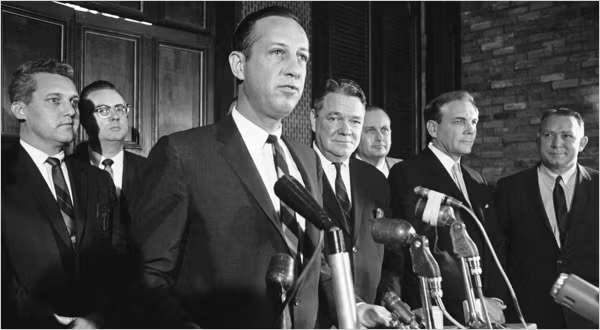
Even when those on stage include a governor; a congressional majority leader and a councilmember at-large who is a future mayor, the most powerful guy in the room is the Commissioner of the National Football League. Fittingly, he is the one at the microphone. Sixty years ago this week New Orleans grew a few notches in urban prestige when NFL boss Pete Rozelle came to town to announce that the city had been awarded a league franchise. New Orleans, a city thought to be a passive, charming, good time town could now literally play in the big leagues.
Moon Landrieu (left side of the picture standing to the right of Rozelle) was mayor- to- be; Hale Boggs (the House Majority Leader standing to Rozelle’s left) and Governor John McKeithern (standing to the left of Boggs) would all be part of the effort that was made possible not just by politics, and crafty urban planning, but an historic social movement.
Appropriately the date was Nov. 1 ( All Saints Day), and the year was 1966, a moment in time that made what was happening possible.
Two years earlier, in 1964, the Civil Rights bill was passed and signed.
Prior to that, many large national corporations, including the NFL, avoided establishing themselves in the deep south where segregation law still applied. After passage of the Civil Right bills changes were set in motion, Atlanta was awarded a franchise in 1965; New Orleans was next the year after.
Another change was in the hotel industry. This photo was taken at the Pontchartrain Hotel on St. Charles Ave. It and the other prestigious hotels; including the Roosevelt and Monteleone, were all locally owned. After passage of the Civil Rights bill, big national and international chains – including Sheraton, Hilton and Meridian – would establish themselves. They proved to be important to economic growth not only because they could attract more conventions but because new hotel taxes on room rates would help finance the Superdome and ultimately the convention center.
To show how attitudes were changing, all of the politicians in the picture would have good credentials on Civil Rights-related issues. As mayor, Landrieu would integrate city government; Boggs was a rare Southern Congressman who voted pro Civil Rights on key issues (and would even pay for it politically.) McKeithen, from hard nosed, conservative North Louisiana, most famously defended the rights of protesters marching from Bogalusa to Baton Rouge.
Beyond the social decency of the Civil Rights Bill, its passage in effect liberated places that had been hindered by the old ways.
In 2006, an important emergency meeting was held in New Orleans. A group of influential people, including business leaders, had been summoned to a session to hear from Paul Taglibue, the NFL’s then commissioner. In the wake of the destruction done by Hurricane Katrina, there was concern that New Orleans would lose the Saints franchise. The Superdome had been badly damaged. Other cities, inducing San Antonio, where the Saints had played most of their home games in the season after the storm, were hungry for a franchise of their own. The mayor of San Antonio even made comments implying that a Saints move to the city was near inevitable. New Orleans was down and out, and the Saints rumors added to the hurt.
That’s why Tagliabue came to town. He told those gathered that the NFL was committed to the Saints staying in New Orleans. (The league even helped with repairs to the dome.) Those who were there would remember how strongly Tagliabue talked in defense of the Saints. He left no doubt. The Saints stayed, the franchise grew stronger, and the biggest surprise, five seasons later, the team won the Superbowl.
Just like in November 1966 when Pete Rozelle delivered his good news, the most important person in the room was still the Commissioner of the National Football League.
-30-
To contact Errol, email elabordenola@gmail.com.
BOOK ANNOUNCEMENTS: Errol’s Laborde’s new book, “When Rex Met Zulu: And Other Chronicles of the New Orleans Experience,” (Pelican Publishing Company, 2024) is now available at local bookstores and websites.
Laborde’s other recent publications: “New Orleans: The First 300 Years” and “Mardi Gras: Chronicles of the New Orleans Carnival” (Pelican Publishing Company, 2017 and 2013), are available at the same locations.
