
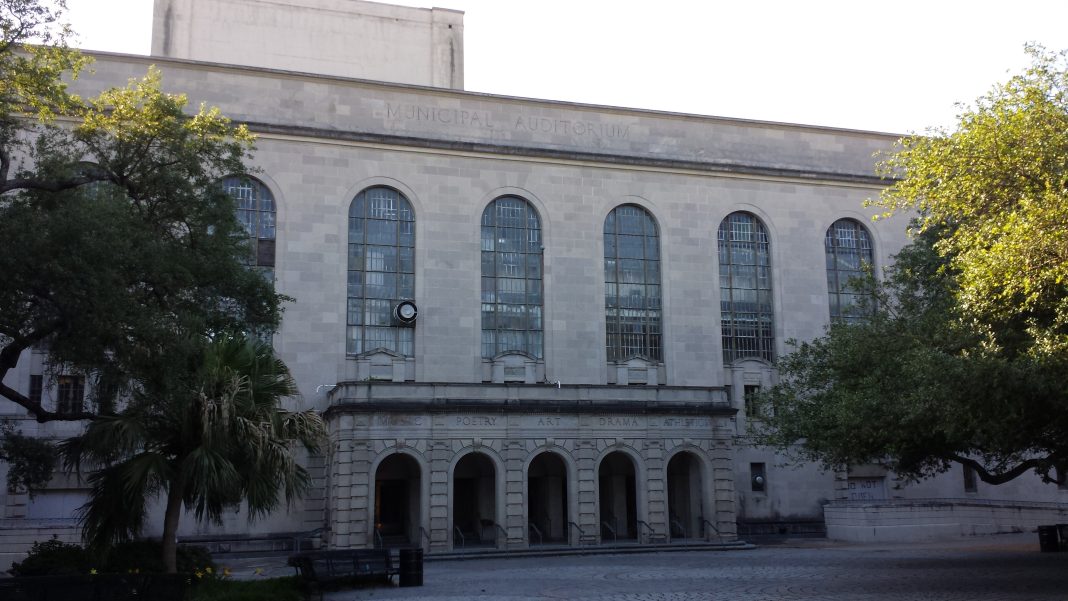
Sometimes there is a public issue that presents a conflict between emotion and practicality.
That’s how I feel about the question of what to do about the city’ s stately, but dilapidated Municipal Auditorium. Opened in 1930 as an impressive multi-purpose entertainment center, it has been closed since 2005 after being ravaged by the effects of Hurricane Katrina. Since then there have been procedural entanglements over the city getting $38 million of funding from FEMA. Recently, that issue seemed to be resolved and City Hall will get its money if it can show progress in spending it by 2028. Now the harder question is how to spend it.
In its day, the building was the go-to place for any major entertainment events, including concerts and special occasions such as graduations. Each year at Thanksgiving time the Shrine Circus would be a regular, bringing in rail cars of elephants plus lions and tigers. Karl Wallenda, once the world’s most famous high-wire walker, brought his circus there as did leading lion tamer Gunther Gebel-Wlilliams.
Hank Williams (no relation to Gunther) brought something extra one weekend when he appeared there with the woman who he would marry on stage during a Saturday performance. The event was so popular that the couple repeated the nuptials for the Sunday matinee. (Unfortunately, despite having taken the vows twice, the marriage didn’t last.)
Especially unique was that the building was designed with Carnival balls in mind. There were two ballrooms positioned back to back, each with their one stage. In 1931, The Elves of Oberon was the first Carnival krewe to promenade the floor; more krewes would follow, including Rex and Comus, who held their events simultaneously on Mardi Gras night. For the hallowed tradition of the Meeting of the Courts, Rex and his entourage would walk down a hallway over to the Comus side for the presentation. For several years, the auditorium was such a popular Carnival ball destination that parading krewes arranged their route through the French Quarter so that they could turn left at Orleans Street and be able to march across Rampart Street to unload at the building’s back door. For visitors, parking was always ample and gated.
One minor problem, especially during one season, arose when the ball dates were early on the calendar. The backstage area would still be enhanced by eau de elephants from the recent Shrine Circus.
Nowadays, there is less demand for a multi-purpose facility because there are more entertainment-oriented places already serving many purposes. Big concerts will now likely perform in the Smoothie King Arena or the Caesars Superdome. The nearby Saenger Theatre was refurbished into one of the nation’s finest stage facilities. (It would have been a great setting, especially with its ceiling illuminated to resemble the night sky, for Hank and his bride to be twice married.)
Circuses, especially those with animals, have become a thing of the past. Cirque du Soleil, with its acrobatics and and stylish presentation, would more likely play in the Superdome or the Arena.
Across Canal Street is the former Lowe’s Theater, once a great and spacious movie house that has long been boarded. The nearby Joy Theater stages smaller Generation X acts. Along Airline Highway, Jefferson Parish operates a fine performing arts center. And in Kenner, the revamped Pontchartrain Center now houses auditorium type shows, as well as Carnival balls that have moved from the city.
Former New Orleans Mayor LaToya Cantrell had proposed converting the auditorium into City Hall, though that got stopped by neighbors. It might not have been a bad idea, one that could have brought business to the neighborhood.
Located in Armstrong Park at the site of what was Congo Square, where dances by enslaved people were held, there have been suggestions of making the building some sort of museum to recall that era. Commemorating the period is a good idea, although I am not sure how to design the concept for the cavernous auditorium.
Known officially as the Morris F. X. Jeff Municipal Auditorium, named after the pioneering organizer of the New Orleans Recreation Department’s early Black recreation program. He was also an active member of the Krewe of Zulu, as well as a king, Jeff’s name might be more appropriately remembered atop a NORD property.
Just as planners are looking for ways to fill abandoned churches, facilities and warehouses, there are sometimes more available spaces than needs. Urban planning is not always just about the future; it can also be about creative ways to repackage the past.
-30-
To contact Errol, email elabordenola@gmail.com.
BOOK ANNOUNCEMENTS: Errol’s Laborde’s new book, “When Rex Met Zulu: And Other Chronicles of the New Orleans Experience,” (Pelican Publishing Company, 2024) is now available at local bookstores and websites.
Laborde’s other recent publications: “New Orleans: The First 300 Years” and “Mardi Gras: Chronicles of the New Orleans Carnival” (Pelican Publishing Company, 2017 and 2013), are available at the same locations.
